





We use cookies to effortlessly improve your experience on our site. Cookies also help us understand how our site is being used, so that we can keep making it better. You can read more about it in our cookie policy and change your settings here at any time.

What is The Gender Index?
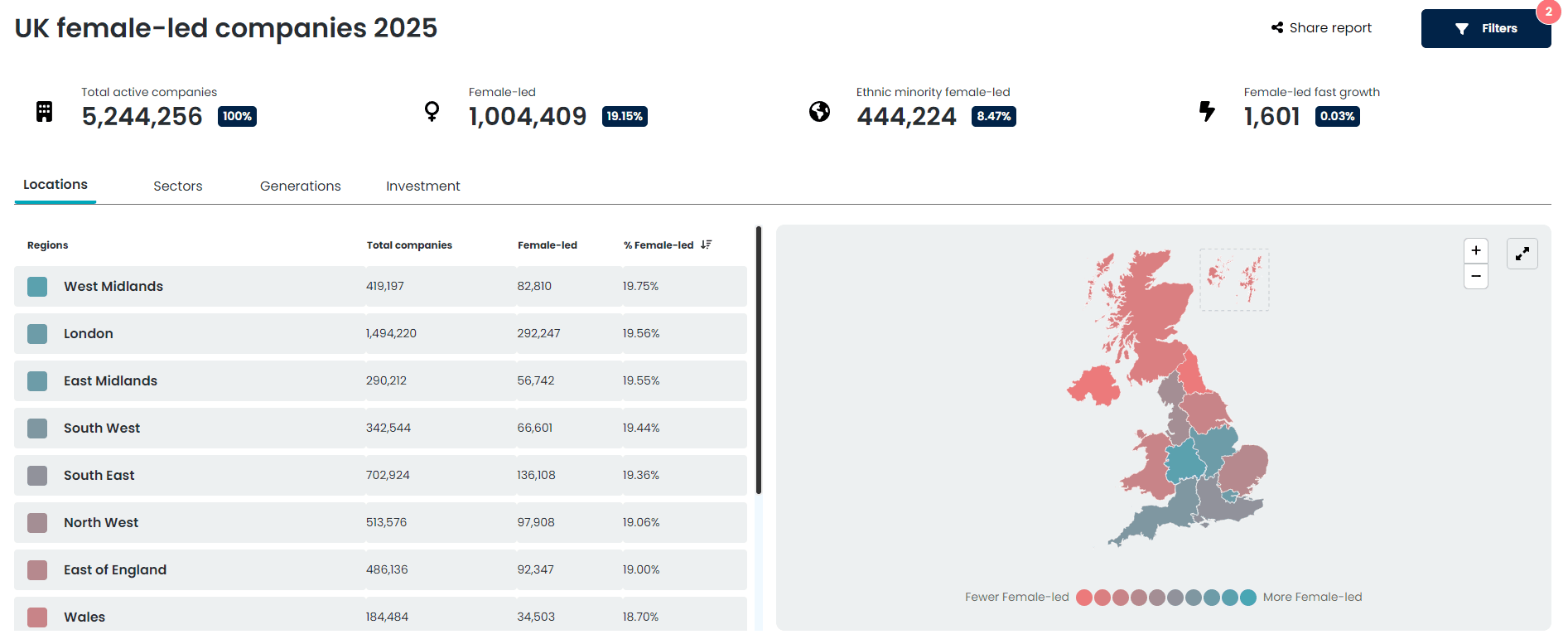
Mapping the impact of female-led companies on the UK economy is crucial for a stronger, more inclusive economy. Yet, a freely available tool to measure their number, potential, and support their growth has been lacking.
Enter our groundbreaking data source, which benchmarks female entrepreneur activity and spotlights the gender gap in entrepreneurship. Join us in using this free data to empower women and bridge the divide.
How does it work?
Our AI-powered tool is one-of-a-kind, mapping all 5.2+ million active UK companies in real-time. With customizable search options, explore insights by gender, sector, investment type, ethnic minority leadership, and more.
Track progress, growth, and trends by various criteria instantly. All the data you need is right at your fingertips.
Who is it for?
Whether you're a female founder seeking growth, a policymaker, journalist, educator, corporate entity, or investor, we've got you covered.
The Gender Index is freely accessible and open for use. Download our annual reports or craft and distribute your customized reports to spark dialogue, ideas, and policy actions. Together, let's propel towards a more equitable future.


The national picture
AI Summary: National data shows a decrease in female-led companies in England by 0.25%, Northern Ireland by 0.51%, and Scotland by 0.16%. Wales experienced a 0.15% increase in the same period. Changing trends indicate a fluctuating landscape for female-led companies across the regions.
Nation
% female-led*
% change**
England
18.22%
-0.25%
Northern Ireland
16.08%
-0.51%
Scotland
17.21%
-0.16%
Wales
17.19%
0.15%
*Active UK companies
**previous 12 months
Female incorporations vs closures over the last 12 months
AI Summary: Female company incorporations have shown a steady increase over the last 12 months, with a peak in March 2026. However, closures have fluctuated, reaching a high in July 2025. Overall, there has been a positive trend in incorporations, indicating growth in female-led businesses.
Generational shift through gender
AI Summary: Generational shift is evident in companies with percentage growth in female-led and other categories, while male-led companies show a decline. Millennials and Generation X are leading the trend, with Gen Z also showing growth. Boomers and Silent generation lag behind in leadership diversity.
Active UK company generation analysis
Investment into active female-led companies
AI Summary: Over the last 12 months, investment into active female-led companies saw a 6.23% growth in venture capital, a 3.74% decline in private equity, a 5.52% growth in angel investments, and an 8.12% growth in other types of investments. Changing trends indicate a shift towards angel and other types of investments.
Investment type
No. of investments*
Percentage**
Venture capital
89
6.23%
Private Equity
16
3.74%
Angel
2.8k
5.52%
Other
1.3k
8.12%
*Last 12 months**of all investments
Female-led sector analysis
AI Summary: Female-led companies in the health, wellbeing and social care sector saw the highest percentage at 36.35%, while arts, entertainment, and recreation had the lowest at 24.03%. Education, public health and safety services, and service sector also showed significant representation. In contrast, energy suppliers, construction, mining and quarrying, logistics, and water and waste services had notably lower female leadership percentages.
Top 5 female-led sectors
%*
Health, wellbeing and social care
36.35%
Education
35.38%
Public health and safety services
32.52%
Service sector
31.42%
Arts, entertainment and recreation
24.03%
Bottom 5 female-led sectors
%*
Energy suppliers
5.66%
Construction
7.41%
Mining and Quarrying
8.21%
Logistics and storage services
8.93%
Water and waste services
9.98%
*Percentage of Female-led companies
International trade
AI Summary: Gender plays a significant role in international trade, with 14.30% of importers and 13.33% of exporters in the UK being female-led companies. There is a trend towards increasing female representation in trade, despite the majority being non-female led.
Secured debt gender analysis
AI Summary: Analysis of secured debt by gender shows a 61.48% count for Male-led companies, 24.96% for Other, and 13.56% for Female-led. Trends reveal a higher representation of Male-led companies and a lower percentage of Female-led companies in secured debt.
Percentage of active companies with secured debt
13.6%
Female-led
61.5%
Male-led
25.0%
Other
Made possible by